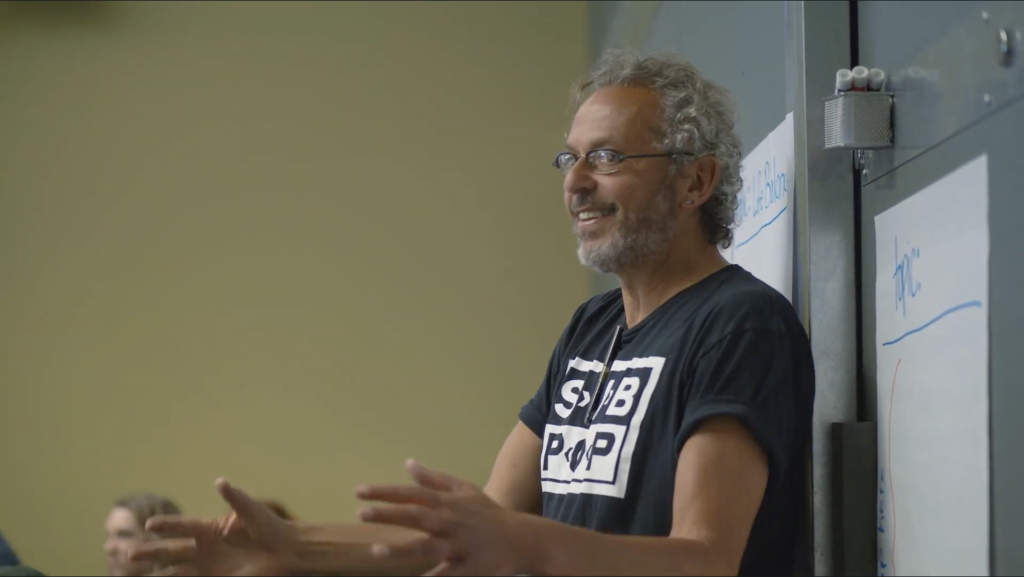
At how many companies do new staff members have a chance to sit down with the co-founder for a searching conversation on mission, vision, principles, and beliefs? Rare as this scenario may be, it’s exactly what happens in the Zingerman’s Community of Businesses (ZCoB), where, every few weeks, Ari Weinzweig teaches the “Welcome to the ZCoB” orientation class. (For Ari’s perspective on why leading the class is still so important to him, check out this thought-provoking essay.)
As a recent addition to the organization, Cary Gitter, Zingerman’s Special Beat Reporter, participated in this unique experience earlier this spring, along with six other new members from throughout the ZCoB—two hosts, a bartender, and a dishwasher from the Roadhouse; a Mail Order crew member; and a Candy Manufactory retailer. And in the open-armed Zingerman’s spirit, an outside guest was also present simply to listen and learn.
They sat at their tables, sipping coffee and noshing on the Bakehouse’s beloved Sour Cream Coffee Cake and Pecan Raisin Bread, until, at 9 a.m., Ari arrived and they got down to work; work that “astonished [Cary] in the best possible way.”
In his disarmingly down-to-earth manner, Ari took the attendees through his own improbable personal journey—from studying Russian history at the University of Michigan to snagging a job as a dishwasher at the now-gone Ann Arbor restaurant Maude’s. It was there he met Paul Saginaw, with whom he eventually founded Zingerman’s Delicatessen in March 1982. Their initial aim: to bring classic Jewish comfort food and other specialty fare to a city that needed it. The rest is rich, delicious history you can read up on here.
As Ari spoke, the power of storytelling became evident—and of hearing your organization’s story directly from one of the people who built it from the ground up. It makes one feel connected to something larger—part of a legacy of meaningful work, hard-won growth, and continued evolution.
This sense of connection only deepened when the core of the class was reached, exploring Zingerman’s mission and principles, and its distinctive business perspective. With Ari as their guide, they were suddenly discussing the biggest of ideas: the vital importance of crafting a vision for the future; the ways that organizational systems and culture interact; how to break the cycle of negative beliefs and build positive ones in their stead.
And they were engaged in all this practical philosophy, over coffee cake on an otherwise ordinary morning!
Another thing that struck Cary about the session: it wasn’t a one-way street. It was very much an open dialogue in which they were each invited to share their own individual backgrounds and viewpoints. What do Zingerman’s principles mean to them? What are their own personal visions, and how can they contribute to the overall vision of the ZCoB going forward?
In his essay on the class, Ari draws on the late cultural anthropologist Mary Catherine Bateson’s concept of “homecoming,” which she defines as “creating an environment in which learning is possible.” Ari writes:
This class is a bit about coming home to ourselves, at least in the context of work. … For many, I realize, this might be the first time in their work history that their full humanity is acknowledged. Where, regardless of role … they have someone at work encouraging them to be themselves, to study, and to learn. Someone sharing a vision and meaningful mission, appealing to their ethics. Showing them how to caringly and effectively challenge organizational norms—to step forward and think like leaders.
“Coming home to ourselves”—what a beautiful notion; one that Cary felt firsthand. Whether in a kitchen or at a desk, we’ve all worked in (probably many) places built on rigid hierarchies, where we’re treated less as people than as means to a corporate end. In Cary’s case, as someone who has balanced a creative writing career in theater and fiction with professional writing jobs in marketing and media, he’s long felt the need to compartmentalize these dual paths—and to show up in the latter settings as the limited “work” version of himself.
That’s what makes “Welcome to the ZCoB” such a singular class. It’s not just another rote orientation covering company rules and regulations. It’s an opportunity for new Zingerman’s team members to come together as human beings and talk about the stuff that really matters. To feel empowered by the idea that they’re all, in Ari’s words, “100 percent responsible for the whole organization.”
Cary found himself genuinely startled when 11:45 rolled around and their time was up; the nearly three hours had flown by. Ari would soon be on his way, but the rest of the cohort still had an afternoon of activities ahead: a valuable introduction to diversity, equity, inclusion, and belonging within the ZCoB, and an illuminating class on “The Art of Giving Great Service.” First, however, there was a hearty lunch. This is Zingerman’s, after all.
Seated at a table in the common room at ZingTrain, enjoying a plate of Roadhouse Macaroni & Cheese and a portion of Reuben sandwich from the Deli, Cary found himself processing the entirety of the morning. Just two weeks into his time in the ZCoB, he’d joined his colleagues from various corners of the organization for a communal experience of learning and reflection. And for their teacher, they’d had none other than Ari himself, who, with humor, humility, and generosity, offered decades of accumulated knowledge and wisdom—amid his own ongoing quest to learn more.
When lunch was over an hour later, they drifted back to the conference room, digesting their food as well as their thoughts. They refilled their coffee mugs or grabbed a soft drink from the fridge. Then they returned to their tables to resume their fruitful work—although, at least for Cary, it felt a bit like they were coming home.
Interested in joining the ZCoB? Browse our open positions.