I love cooking. First of all, it’s fun! Creating something with my hands, transforming a myriad of ingredients into something delicious and nourishing, the act of feeding others and gathering around the table. What I especially love about cooking is being able to put something together on a whim, and adjust the ingredients or how I am cooking on the go as I am loosely threading a rough base of fundamentals.
Baking bread also brings me joy with a similar yet different feel. It’s slower, more methodical and definitely requires a bit more planning, a bit more patience. Ingredients—flour, water, salt and yeast at its most basic—are simple, but their transformation is drastic. To get to great bread, a baker needs to stick with a recipe, following the prescribed, time-tested ratios of these ingredients as they bring them together. Not to underplay the role of great ingredients in cooking as well but those simple ingredients that make up a loaf of bread hold quite a bit of power. Under skilled hands and proper technique, they can be transformed into something so delicious, nutritious and beautiful that doesn’t taste or look anything like the initial ingredients. So, we believe that knowing more about the humble flour, water, salt and yeast, can help us get closer to our ideal bread and maybe have a bit more fun along the way.
Feel free to nibble away at your favorite bread as we touch on each of these ingredients in this blog piece. If you are ready for a deeper dive, you can join us at BAKE! for our Mindful Baking series which takes you on a theoretical journey of bread baking from ingredients to sourdough.
Flour
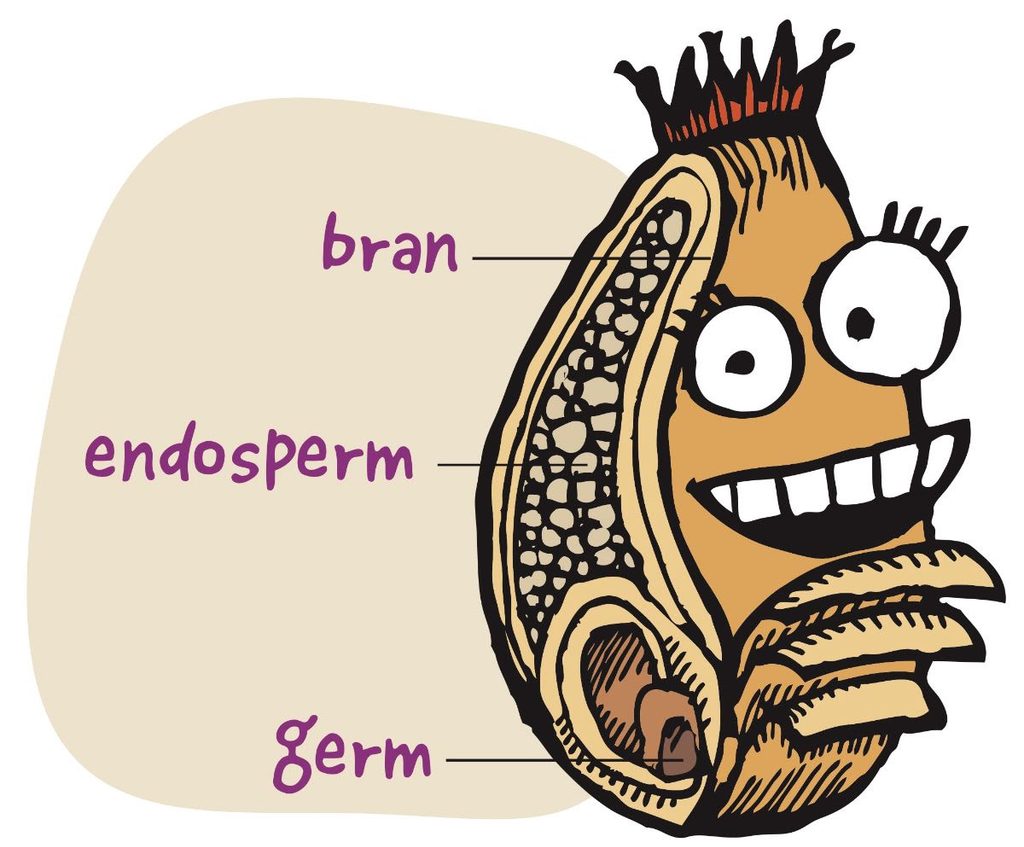
Flour is the backbone of bread baking. In this case, we are talking about wheat flour that is made up of the ground seeds of wheat grass. This seed, also known as a wheat berry, is made up of three main components of importance to us bakers—namely the germ, endosperm and the bran.
The germ, a very small proportion of the berry, is where new life sprouts when the temperature and moisture conditions are right. It’s full of vitamins, minerals, fats, and contains the wheat’s genetic material. This part lends a lot of flavor to flour.
The endosperm houses starches, or complex sugars, and proteins, both needed for the procreation of the plant. Some of the proteins are water soluble, and some are not. The latter are the proteins that create gluten when flour is combined with water. We can actually feel that under our hands as we knead the dough and it gets more and more elastic. The water-soluble proteins, on the other hand, act as enzymes, or facilitators of reactions that are necessary in living systems. In this case, in response to the growth needs of the plant, some of these enzymes, called amylases, break down starches into simpler sugars that the plant can use as its energy source. As those enzymes are also carried over into flour, this natural process also helps the conversion of starches into simple sugars in the bread dough, which provide food for the yeast (or fuel for fermentation) and sweetness that we taste in the finished bread when fermentation is well managed.
Surrounding the endosperm is the tough bran layer, which is nature’s perfect design for protecting this seed against outer elements. Bran is full of fiber and minerals, as well as some proteins, imparting color and flavor to flour. Minerals are also a good source of fuel for fermentation.
Broad Categories of Wheat and Wheat Flour
There are many types of wheat, broadly categorized by the climate they are grown in (planted in spring or fall), their hardness (how hard the grain is) and color (red or white). There are, of course, additions to this categorization, such as the hardest of them all, durum wheat with its golden color; the more ancient varieties, such as einkorn, emmer and spelt (also known as ‘farro’ or hulled wheats); and many others from heritage (e.g., Turkey Red, a hard red winter wheat) to modern wheats (e.g., Glenn, a hard red spring wheat). Just like the many varieties of apples in Michigan come with their own unique characteristics, wheat varieties come with their own with respect to their flavor and baking qualities.
Generally speaking for the United States baking world, the higher the protein content of the wheat, the stronger the flour is for bread baking. This typically corresponds to harder wheats, such as hard red winter or hard red spring wheats. At this end of the spectrum are high gluten flour (13 – 15% protein) and bread flour (11 – 13% protein). These flours tend to be thirstier; produce elastic doughs that can trap gases from fermentation activity and bake up voluminous loaves; and result in chewier breads as the protein content goes up.
The lower the protein content of the wheat, as is the case with soft white winter wheat for example, the weaker their flour is for bread baking. These types of wheats and flours are more suitable for pastry applications where strong gluten development isn’t key to the success of the bake. On this side of the spectrum are cake flours (5 – 8% protein) and pastry flours (8 – 10% protein). These flours don’t need as much hydration to reach a workable consistency, fall apart easily with not much elasticity and have poor fermentation tolerance, letting fermentation gases escape much more easily compared to stronger flours.
Millers can also blend these wheats in various ratios to produce what’s called all purpose flour, where the flour is strong enough to make great breads and soft enough also to bake up a batch of delicious, tender cookies.
The qualities of these flours can also be impacted by the level of refining they go through. A true whole grain flour, as in whole wheat flour, contains all of the components of the grain. What the majority of the baking world uses is sifted or refined flour, where a certain amount of the coarse bran and germ have been removed from the milled flour (more on this in the Milling Wheat section below). Whole wheat flour tends to be thirstier, has a slightly higher protein content, and results in a richer texture while refined flours are less thirsty than their whole grain counterparts, contain a bit less protein, and result in smoother textured doughs. In our bakery, the two extremes in terms of level of refinement are our freshly stone-ground strong whole wheat flours, used mostly for breads, and the very refined cake flour, used mostly for delicate cakes.
Milling Wheat
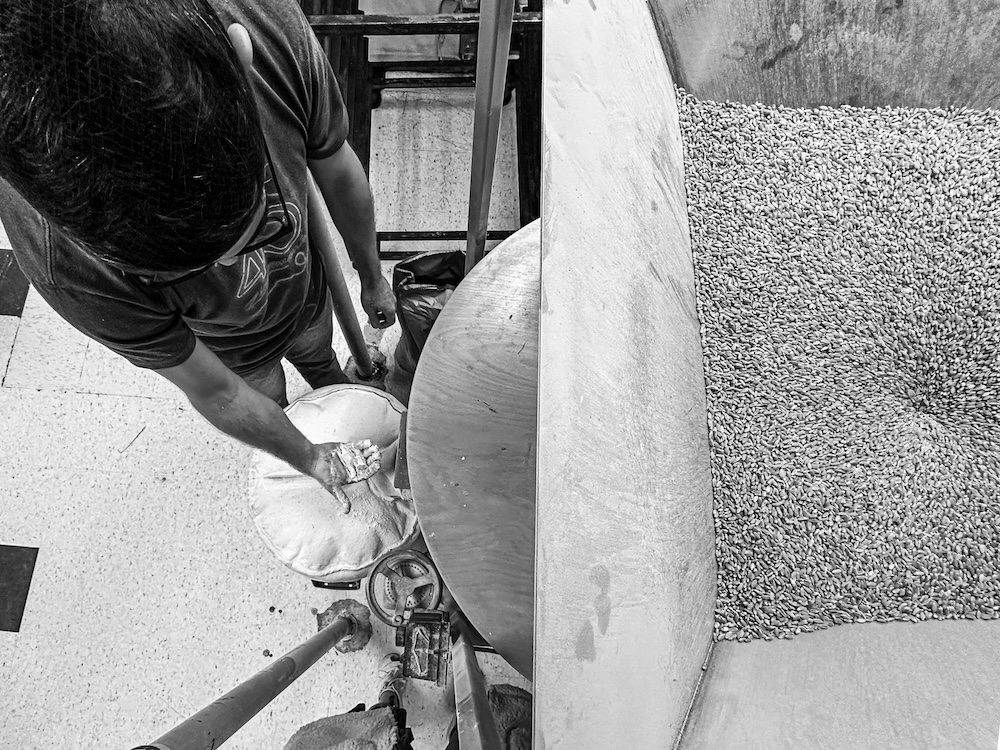
Milling Hard Red Spring Wheat on our stone mill.
Wheat has been domesticated and milled into flour for thousands of years. In our modern world, the two main types of milling include roller-milling and stone-milling. Stone-milling is closer to the ancient way of milling where the wheat passes through two circular stones rotating against each other. It is the immense pressure between the stones that breaks up the wheat berries into very small particles, resulting in flour. Without any sifting, stone-miling produces whole grain flour where all of the components of the wheat berry are retained. A bit of sifting can produce what we call high-extraction flour, which retains a lot of the oils and flavors of a whole grain flour without most of the coarse bran and with the lighter texture of a more refined flour. Roller-milling involves a set of pairs of corrugated steel rollers that rotate against each other. When wheat starts passing through the rollers, the bran layers and germ are removed first, followed by the eventual grinding of the endosperm into various streams of flour on the consecutive sets of rollers. Roller-milling came out of the industrial revolution as a way to produce flour as efficiently and cheaply as possible. In the process, bran and germ are typically removed for the most part, to prevent rancidity and extend shelf-life of the milled flour.
A roller mill.
At the Bakehouse, we use both roller-milled and stone-milled flours (with no additives) in various proportions, and make great artisan breads and pastries. You can do that at home too following proven recipes and techniques as each type of flour behaves a bit differently. Stone-milled flours tend to be a bit more thirsty and active in terms of fermentation, and may require a bit more kneading to get to the same level of dough strength as roller-milled flours. Breads, and some pastries for that matter, made with stone-milled flours also hold onto moisture a bit better compared to their counterparts made with refined, roller-milled flours. To learn more on flours and grains, you can visit our previous blogs, such as All About Wheat Flour.
In its simplest form, what allows a baker to turn flour into bread are water, yeast and salt which we will cover next.
Water
First, let’s get one thing out of the way… you might be curious: Can I use any water for making bread? Potable water that you are ok with drinking, whether it is from the tap, a well, or a bottle, can work well for bread baking. Water that is too soft (i.e., not enough minerals, as in distilled water) or too hard (i.e., too many minerals) may impact the dough negatively both in terms of handling, fermentation or flavor. Water with chlorine that you can smell might also hinder fermentation activity, especially for the more sensitive wild yeast and bacteria in sourdough. If that is the case, filtering it can make the water usable for bread baking.
It should be no surprise that water is the source of life for flour. In the mixing bowl, water hydrates the flour and all of its starches and proteins, as well as the salt and the yeast. Simply, all the dry ingredients… This marks the beginning of various physical, chemical and biological reactions in bread making. Some components dissolve, some disperse and some start bonding. A viscous dough starts forming. Gluten, which gives the dough its elasticity and later on helps trap fermentation gases, starts developing. Enzymes kick into action, breaking starches down into sugars. Yeast comes to life and starts fermenting the forming dough by feasting on sugars, producing alcohol and carbon dioxide.
Water is the main ingredient that impacts the temperature of the dough thanks to its high heat capacity. So, bakers use water to regulate dough temperature as it is critical to the success of and duration of fermentation. Colder dough will ferment more slowly. Water also dictates the consistency of the dough, influencing how it will behave at the bench and how it will ferment. A stiffer dough is easier to shape, and takes longer to be ready for the ovens. A wetter dough feels more slack, sometimes stickier and harder to shape, and may need to hit the ovens sooner. On the flip side, bread made with a stiffer dough may have a drier texture and a shorter shelf life than one made with a wetter dough.
All types of breads, when made well, have their own unique flavor profiles and textures; that said, wetter doughs can coax a bit more sweetness and flavor from the grain compared to stiffer doughs.
Yeast
Yeast is a single-celled fungus, whose role in fermentation was revealed by Louis Pasteur in the mid-19th century as he was trying to figure out why vats of beet juice were souring rather than turning into alcohol. To produce energy, yeasts break down sugars into carbon dioxide and water in the presence of oxygen (i.e. respiration, as in breathing) or into alcohol and carbon dioxide when they run out of oxygen (i.e. fermentation). It is this second process that is responsible for the magic of bread making (and yes, beer making too!), converting flour into something palatable, even delicious and nutritious. Fleishmann brothers built on Pasteur’s discovery and started commercially reproducing yeast, specifically the strain saccharomyces cerevisiae, making it available for commercial as well as home bakers in the United States. Their entrepreneurial idea was to improve upon the not-so-great bread of the United States in the mid-1800’s by using compressed yeast as they did back in their European homeland. It worked! Today, various forms of commercial yeast are widely used in the food and beverage industry.
In the world of bread baking, all that the yeast needs to do its magic is a food source, some moisture and warmth, and some oxygen at least initially (oxygen is quickly used up by the yeasts in the dough environment). The bread dough provides these conditions in a hydrated viscous environment. While the yeasts can survive a wide range of temperatures, from fridge temperatures up to almost 120 F, the sweet spot for both flavor and gas production for breads is in mid-70s F. Fermentation, simply put, leavens, flavors and makes the resulting bread more digestible for our bodies. While the carbon dioxide and various other aromatic compounds are trapped in the glutenous-starchy matrix of the dough, the alcohol evaporates during baking leaving behind more flavor compounds in the finished product. Long yeasted fermentations further enhance the flavor aspects of the bread with the production of some organic acids, which also aids its shelf life (organic acids are a lot more pronounced in sourdough).
At the bakery, we use mostly fresh yeast as well as the more dry, concentrated instant yeast for our baking. While both work equally well, one thing to keep in mind is that fresh yeast is very perishable and requires refrigeration while instant yeast is more stable at room temperature and does not need refrigeration until it is opened. You can learn a lot more about yeast in our All About Yeast blog.
Salt
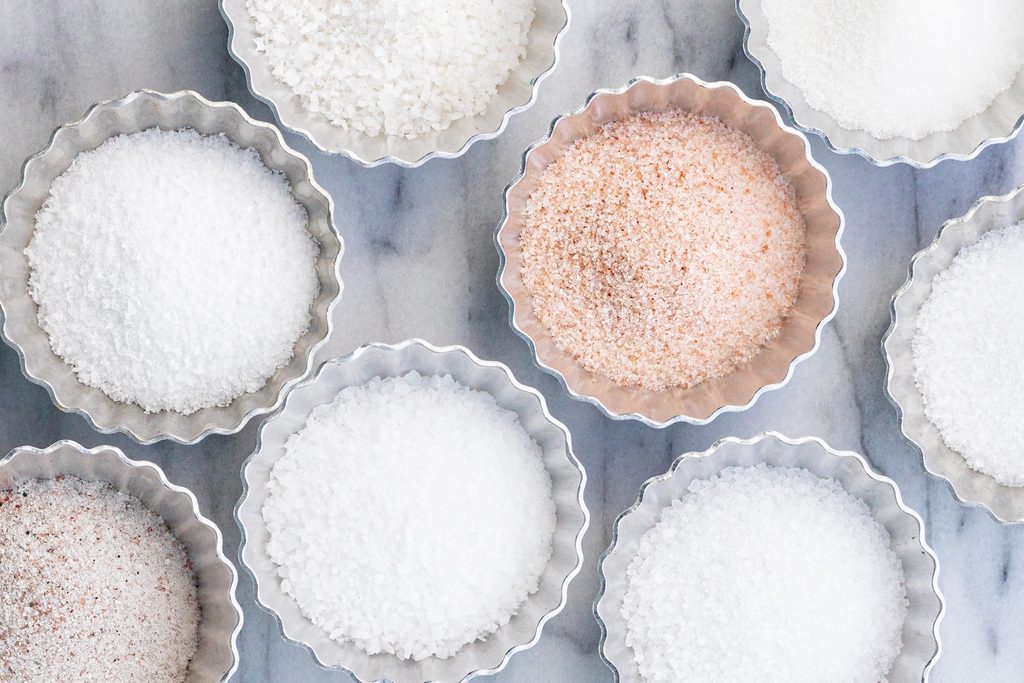
In a way, salt rounds up the humble ingredients needed to make great bread. The salt we are talking about is the same salt you use for your cooking, table salt or sodium chloride. It is a common practice for me and my baker friends to taste our doughs to make sure we didn’t forget to include it in our bread doughs (yes, it happens, even if rarely). While many varieties of salt, ranging from kosher to iodized, would work in baking, the salt we like to use at the bakery is fine sea salt. We like the fine granulation as it simply dissolves and disperses more easily, and it comes with trace minerals that may be a very subtle complimentary flavor nuance for our baked goods. Because salt comes in various sizes and shapes, such as flakes, crystals, coarse or fine, we recommend using weight measurements in your baking rather than going by volume to ensure the right amount called for your bread.
As in cooking, salt helps bring out the flavors of the grain and fermentation; it’s how you season your flour essentially. Without salt, your bread would taste bland. In some cultures, saltless bread does have a place, as in the Italian Tuscan bread, where it is served to complement the already very flavorful ingredients or dishes it is served with. In general though, an average of 2% salt (by total flour weight) is a good amount for a bread recipe.
Because of its chemical make-up, salt is hygroscopic, or it draws water from its surroundings. This means two things for bread: firstly, it helps temper the rate of fermentation. By drawing water out of yeast cells, it slows down yeast activity, which results in more residual sugars in the dough at the end of the fermentation process and better coloring in the oven, hence more flavor and aromas. Secondly, it helps the baked bread hold onto moisture better than it otherwise would, extending its shelf-life (on the other end of the spectrum, in a very humid environment, like we experience during Michigan summers, a crisp baguette can turn into a softer, rubbery one in a couple of hours).
Salt is also an antioxidant, which can slow down the oxidation that happens during mixing. While this is not an issue for hand-mixing, it can be a factor to consider for long mixes of doughs in professional mixers where excessive oxidation can literally whiten the dough and strip away some of the flavor compounds. Salt’s antioxidizing nature further means that it reacts with the forming gluten strands, in a way tightening/strengthening them, which becomes really evident in the mixing bowl if the salt is added later after a dough has already been formed. Because of this effect, some bakers like to add salt after the initial dough formation rather than at the beginning of the mixing process, as we do for some of our breads here at the bakery, in order to facilitate an easier initial gluten formation.
If you are further interested in learning about various kinds of salts and their nuances in baking, you can enjoy more reading with our All About Salt blog.
Originally from the island of Cyprus, Hazim decided to immerse himself in the world of bread baking and all foods fully flavorful after a career in environmental engineering. He joined the Bakehouse team in 2016 with a focus on bread quality and innovation. You may find him at the bench with his baker friends rolling Farm dough, milling flours on our stone mills, teaching a Naturally Leavened Bread class at BAKE!, tasting breads, loudly (he calls it "passionately") elaborating on the benefits of whole-grain flours or temperature for sourdough baking, or stopping in his tracks to think about the next possible bread or improvement. Science is dear to him, and he loves windsurfing!! He was recently featured on Rise Up! The Baker Podcast with Mark Dyck talking about getting his start in baking, the tension of leaping into a new career, and working on a team where he can be his whole self.