You typically hear us get excited about great ingredients that we use in our baking. In this piece, we are shifting our focus a bit. It’s about an ingredient that we’ve stayed away from all the years we have been in business. Bromated flour, a commonly used type of flour by many bakers in the US, has been on the news recently as the state of New York is taking steps to outlaw its use due to health concerns that potassium bromate, the additive in this flour, has been known for. What follows is us getting curious and sharing with you some background information on this additive, the latest developments and what you can do in your own baking if you happen to be a baker and want to make the switch to non-bromated flours.
More Than Flour
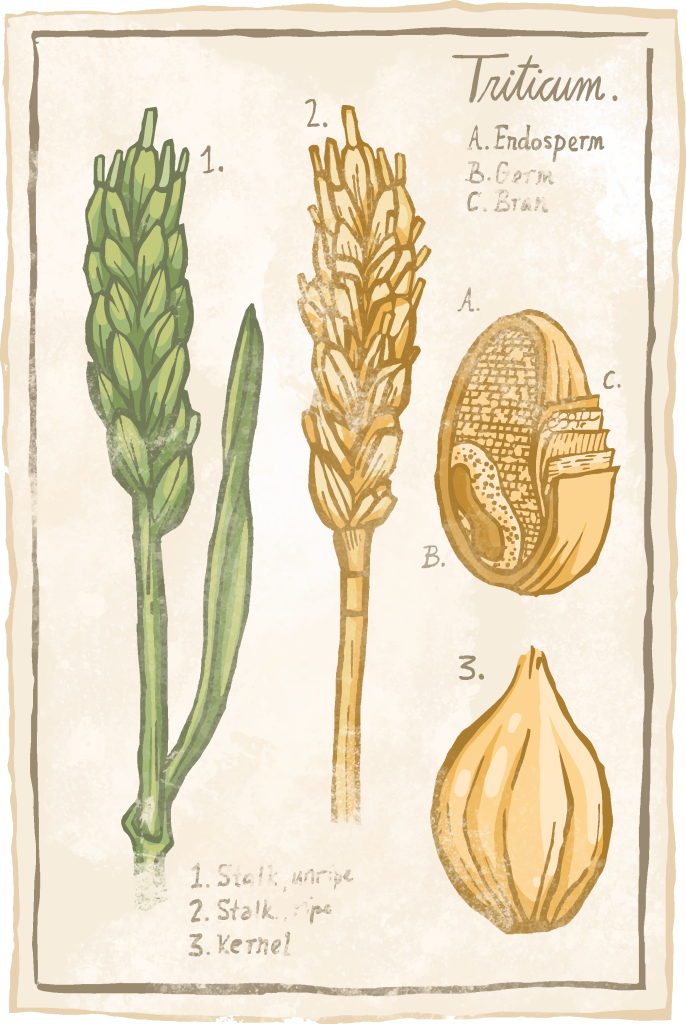
The anatomy of wheat.
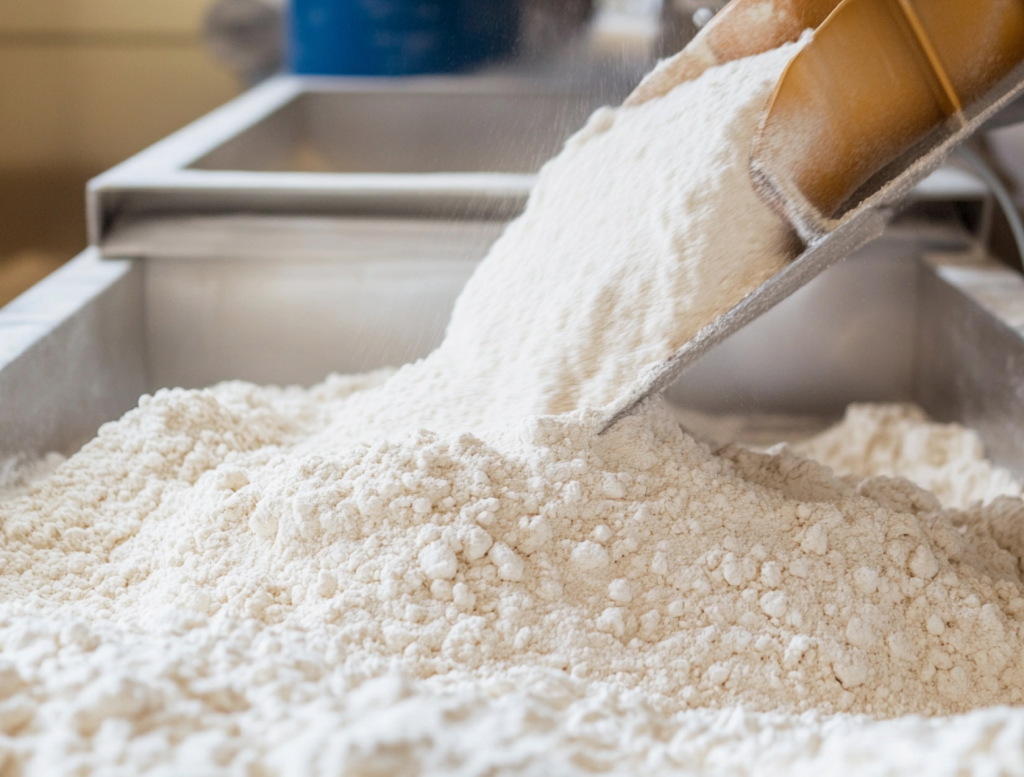
Flour that we use for baking, whether it’s for bread or pastries, comes from the seed of wheat grass. That seed, more commonly known as a wheat berry, is milled into powder that we call flour. Sometimes, it’s whole grain, like a whole wheat flour—meaning it contains the germ, endosperm, and the bran parts of the berry—or sifted, like an all-purpose flour—meaning some of the bran and the germ have been sifted out. Flour, whether sifted or not, naturally has what’s needed to provide structure, flavor, and nutrition to our breads and pastries, given proper recipes and techniques.
That said, if you have paid attention, flour in a bag is sometimes more than just flour. In some cases, it’s enriched, meaning Vitamin B compounds and iron have been added in to compensate for the nutrients that are removed when the bran and germ are sifted out. Before the Bakehouse switched to organic all-purpose flour, our main flour was an enriched all-purpose flour. Sometimes malted barley flour is added to optimize enzymatic activity, the barley facilitating the conversion of starches into the sugars that fuel fermentation. Our current organic all-purpose flour is supplemented with a smidge of malted barley flour. In other cases, flour is treated to change its baking characteristics, typically in the form of oxidation.
Flour starts oxidizing naturally on its own as soon as it is milled and exposed to air. This natural oxidation process, which can take at least a few weeks, stabilizes the flour’s gluten-bonding characteristics, therefore improving its baking qualities compared to when it was just milled. You may be thinking, what about freshly milled flour then, like the ones we mill and use at the Bakehouse? Well, the gain in flavor and aroma from freshly milled flour, in our opinion, more than compensates for the not as optimal baking characteristics that such flour may have. And to the extent possible, we also adjust our processes and recipes to accommodate its baking qualities. That is part of the fun of working with freshly milled flours.
Back to flour treatments, industrial mills sometimes choose to artificially oxidize flour by either subjecting it to or supplementing it with additives, such as chlorine gas, azodicarbonamide (ADA), calcium peroxide, potassium and calcium iodate, or ascorbic acid (vitamin C). This type of flour oxidation expedites the aging process we mentioned above (storing flour so it can naturally age means holding onto inventory, which can be an added cost), bleach the flour (whiter-colored flour, more tender cakes), and/or enhance its baking characteristics (typically stronger doughs and more voluminous breads). The other additive in the industry’s oxidizer toolkit that has been controversial and recently (re)made headlines is potassium bromate, the subject of this blog piece.
Industrial flour is sometimes artificially oxidized with potassium bromate.
Potassium bromate (with chemical formula KBrO₃), a slow-acting oxidizer in the form of a white powder, made its debut in the baking industry in the early 1900’s as a low cost flour improver or dough conditioner. The way potassium bromate works is that it interacts with gluten-forming proteins and starches in the flour, facilitating the formation of disulfide bonds, improving starch gelatinization, viscosity, and swelling, and augmenting dough strength. Bromate is active throughout the mixing, fermentation and baking processes, increasing dough/fermentation resiliency and resulting in breads with greater volume. When it is used within the recommended dosage in the flour, it is reported to be depleted and converted into a derivative compound under optimum baking conditions. However, when it is used in excess and/or the baking conditions are not optimal (i.e, not hot or long enough of a bake), some bromate residue may remain in the baked product. And that’s where safety concerns arise with this popular and effective flour improver.
Various studies from the scientific community have demonstrated its link to negative health effects, including cancer, in both laboratory animals and humans. Numerous countries have since banned its use in food products—the EU (1990), Canada (1994), China (2005), and India (2016).
The story is a bit different in the United States. The Food Additive Amendments of 1958 required, for the first time, safety testing of substances by manufacturers before adding them to food; yet, potassium bromate (and some other additives) slipped through the requirements, as it was already on the market and deemed ‘generally safe’.
Today, potassium bromate is on the “List of Select Chemicals in the Food Supply Under FDA Review” with no federal ban on its use as a food additive. Instead, the FDA has only encouraged bakers (with limited success) to voluntarily stop using it.
Movement on a More Local Level
The state of California however led the way by listing it as a carcinogen in 1991 under its Proposition 65 and started requiring warning labels on baked goods containing this additive. So, most bakers switched to non-bromated flour in their processes. California further solidified its stance with a law more recently, which will make potassium bromate in food items illegal starting in 2027.
New York is the second state to follow suit. Just this Spring, the lawmakers passed a bill that bans potassium bromate from any food sold in the state. The bill is awaiting final approval. If it goes through, a lot of bagel and pizza makers of New York will have to oblige, forgoing their bromated flour that some have been using for decades. While some are embracing this potential big change coming their way, some are reacting due to potential needed changes to their processes or increase in flour cost (source: NYT article – Will a Ban on This Flour Change New York Bagels and Pizza?).
Standing up against potassium bromate is also the state of Arizona, at least in its public schools where school meals are federally funded. The state passed the Arizona Healthy Schools Act into law in 2025, prohibiting serving and selling of ultra-processed foods containing a specific list of additives, which includes potassium bromate. The ban will be effective during the 2026 – 2027 school year.
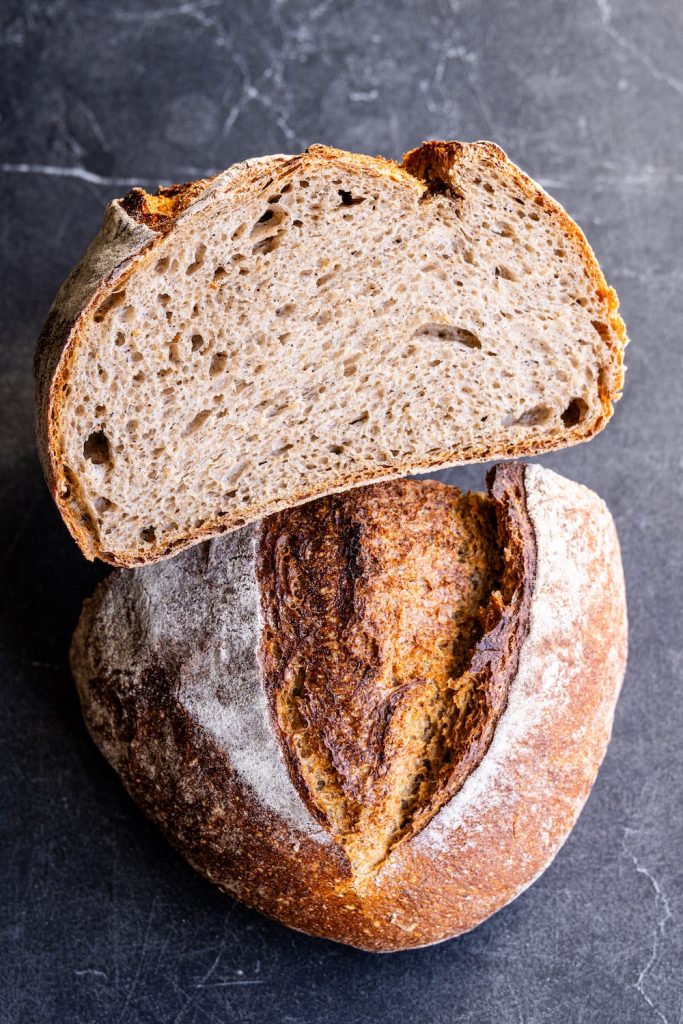
A beautiful loaf of our naturally-leavened Country Multigrain Bread made with whole grain organic buckwheat, regional high extraction hard red spring wheat, freshly milled organic spelt, and organic rye.
Here at the Bakehouse and our BAKE! school, we believe that great baking is totally doable without potassium bromate in the flour. In our 34-year history, we have never used bromated flour in our baking, and still managed to bake the beautiful-looking, delicious breads and pastries. A skillful baker can easily adjust their baking to accommodate the lack of the dough improver effects imparted by potassium bromate. A bread dough may simply require a bit more mixing to achieve the same level of gluten or strength development, a more robust fermentation to promote natural dough strengthening, or similarly the addition of a preferment (like a poolish or levain) to help naturally condition the dough and optimize its fermentation tolerance. A natural oxidizer and a dough strengthener, Vitamin C, can also come in handy, especially for weaker flours to boost elasticity. Of course, another option is to look for a recipe that was developed using non-bromated flours. Either way, once you get used to the baking characteristics of non-bromated flours, it becomes the new normal. In today’s baking world, where artisan bakers are working more and more with locally grown and milled flours with no additives and still produce beautiful, flavorful baked goods, we have no doubt that you can do it too. If you don’t want to brave it alone, you can also bake and learn with us at our baking school BAKE! using non-bromated, organic and even freshly milled flours.
Originally from the island of Cyprus, Hazim decided to immerse himself in the world of bread baking and all foods fully flavorful after a career in environmental engineering. He joined the Bakehouse team in 2016 with a focus on bread quality and innovation. You may find him at the bench with his baker friends rolling Farm dough, milling flours on our stone mills, teaching a Naturally Leavened Bread class at BAKE!, tasting breads, loudly (he calls it "passionately") elaborating on the benefits of whole-grain flours or temperature for sourdough baking, or stopping in his tracks to think about the next possible bread or improvement. Science is dear to him, and he loves windsurfing!! He was recently featured on Rise Up! The Baker Podcast with Mark Dyck talking about getting his start in baking, the tension of leaping into a new career, and working on a team where he can be his whole self.