Yes, you read that right. Bakers like it hot and steamy… in their ovens, that is. If you’ve ever taken a tour of the Bakehouse, you may have seen bakers loading bread into the ovens and then pressing a button on the side. That is their professional way of injecting steam into the oven chambers so that the breads can bake to their full potential, in terms of visuals, texture, and flavor. The same is true for the delicious, buttery and flaky croissants you can see lined up in our Bakeshop. Steam plays an important role in the baking of bread and viennoiserie leavened with yeast or sourdough. How so? Let’s talk about it.
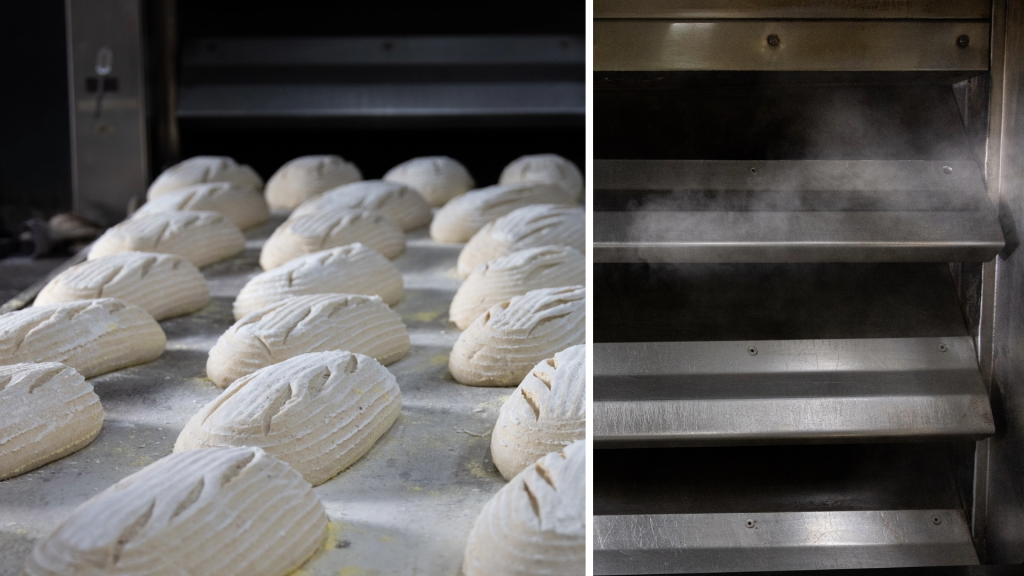
Left: Farm loaves on the loader, scored and ready to go into the oven. Right: Some steam escaping the ovens.
Delay in crust formation
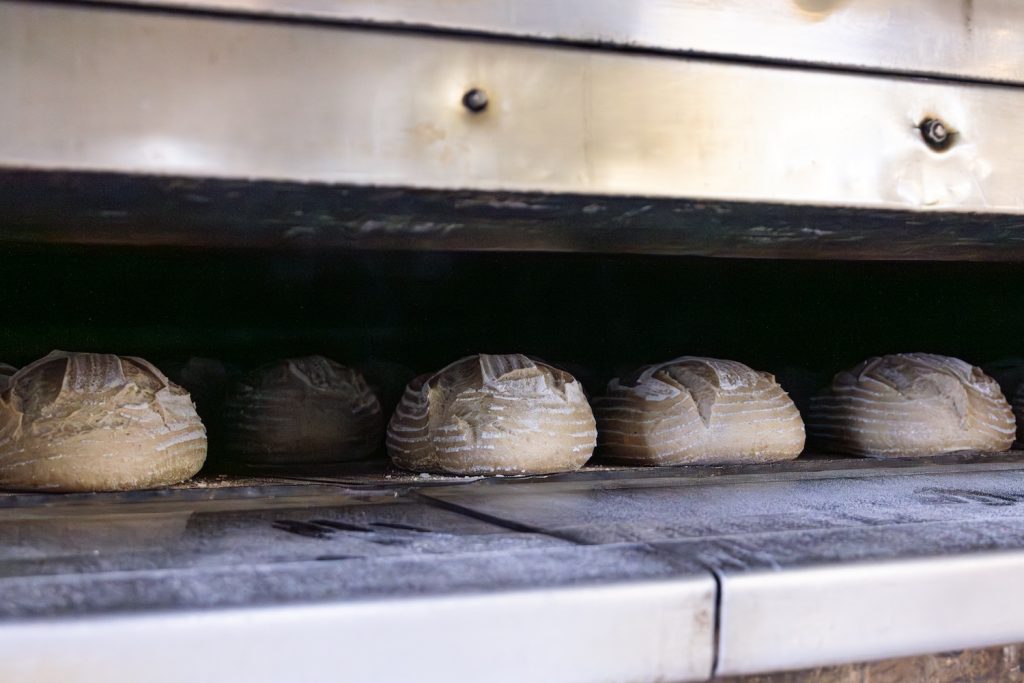
A proofed bread dough that is ready to go into the oven has undergone mixing, (bulk) fermentation, shaping, and some more fermentation (proofing). It’s full of carbon dioxide trapped in a somewhat fragile, glutenous, starchy matrix. When this dough goes into the oven, the heat causes the trapped gases to expand and at the same time, gives the yeast and bacteria one more boost to produce some more carbon dioxide before they die. The bakers call this the oven spring.
Farm loaves in the oven, having reached their full oven spring and ready to color.
While the dough expands in the hot oven chamber, the surface starts to dry out and harden and eventually turns into what we know as the crust. Before that hard crust forms, though, a baker’s goal is to have the dough expand to its full potential. And that’s where steam comes into play. Bakers steam their ovens for the first part of the bake while the oven spring drama unfolds. The steam condenses on the surface of the dough (which is cooler than the chamber of the oven) and keeps it soft and pliable long enough to allow for that expansion.
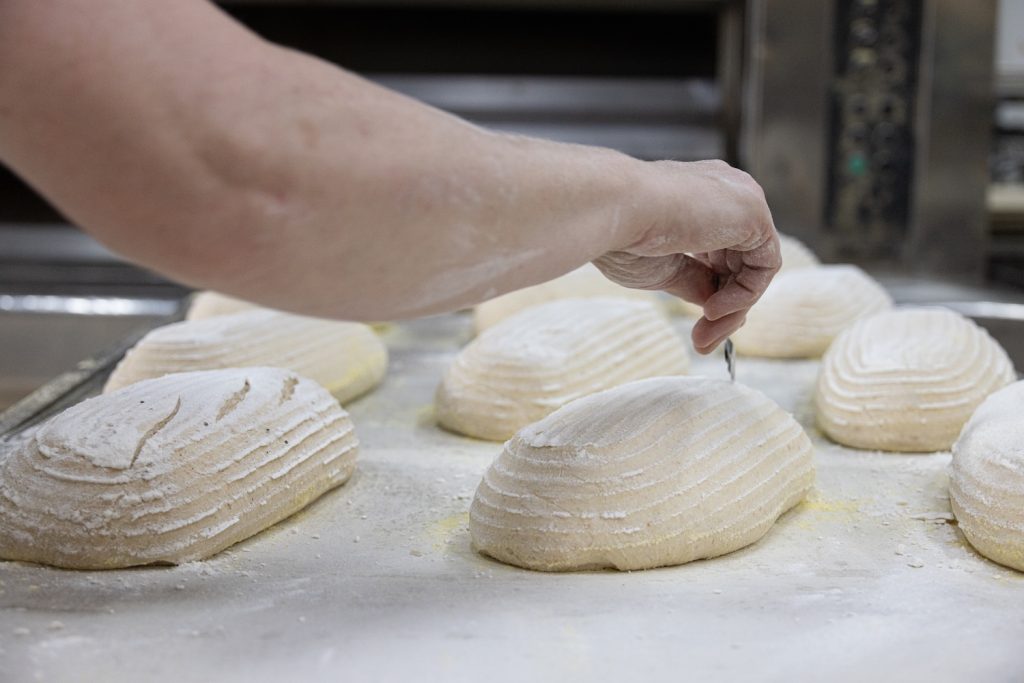
Scoring the bread also helps with the oven spring by allowing some of the expansion to occur along strategically placed shallow cuts on the surface of the dough. This adds to the aesthetics of the bread as well. If all goes well with mixing, fermentation, and shaping, a properly steamed bread will achieve the desired size and shape, with a light texture and holes distributed throughout the crumb. When you cut into a loaf like that and give it a squeeze, it ‘breathes’ allowing you to experience its aromatic qualities more fully.
Scoring loaves facilitates the oven spring.
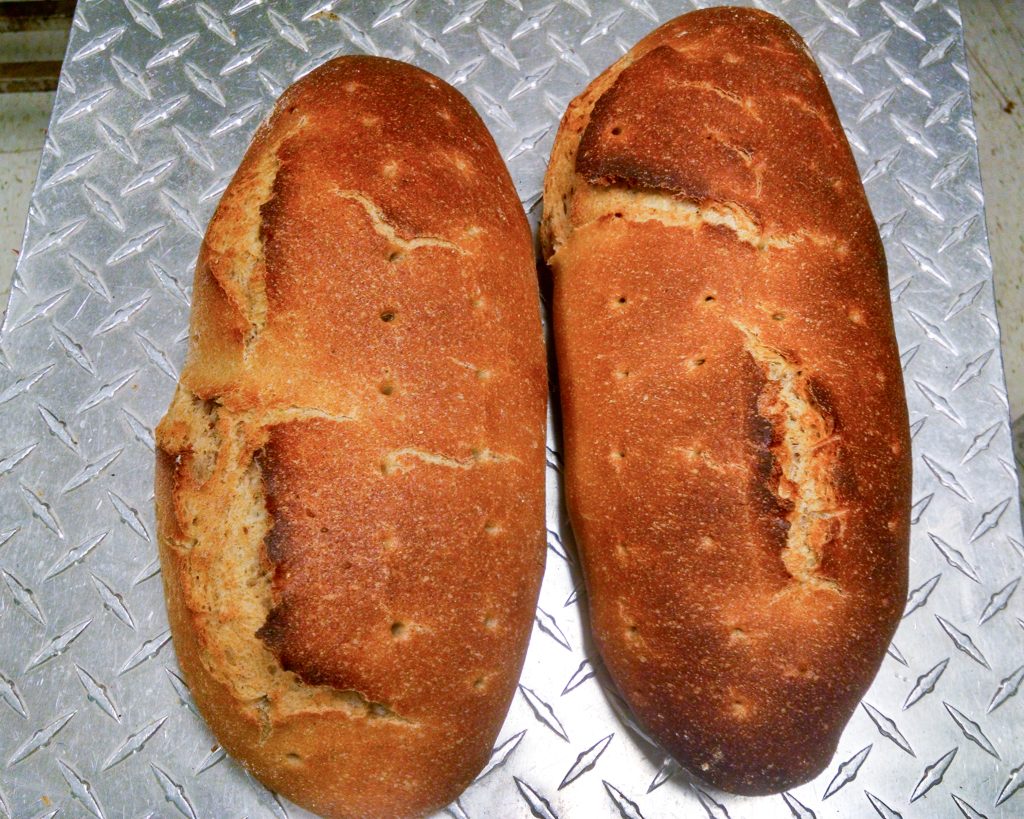
Of course, there is a limit to how much steam is needed for the optimum oven spring. Too much steam can cause the dough to collapse onto itself and create a rubbery crust. Too little steam or no steam, on the other hand, can cause the crust to prematurely form before the dough can fully expand. When that happens, the gases force themselves out of the dough through the weakest spot they can find, resulting in what bakers call a blow out and a not-so-pretty loaf. Crumb can be uneven and dense, diminishing the textural quality of the bread.
An unfortunate sight resulting from inadequate steam—the dreaded blow out!
The wonders of the crust
In addition to helping with the oven spring, steam contributes to the formation of that crisp, caramelized crust that we come to expect from a well-baked loaf of bread. Without donning our lab coats to dive deep into the science behind it, moisture from the steam causes the starches on the surface of the loaf to gelatinize, forming a thin smooth skin. This, in turn, besides helping with a pressure-cooker effect for the dough inside, creates an unmistakable shine and paves the way to a well-baked crust via what comes next. First, sugars and amino acids (resulting from the fermentation of starches and proteins in the dough) roll into the flavor and aroma-enhancing cascade of Maillard reactions. Then, as the heat further rises, sugars start to caramelize—yes, you guessed it, as in the caramelization that we associate with candy.
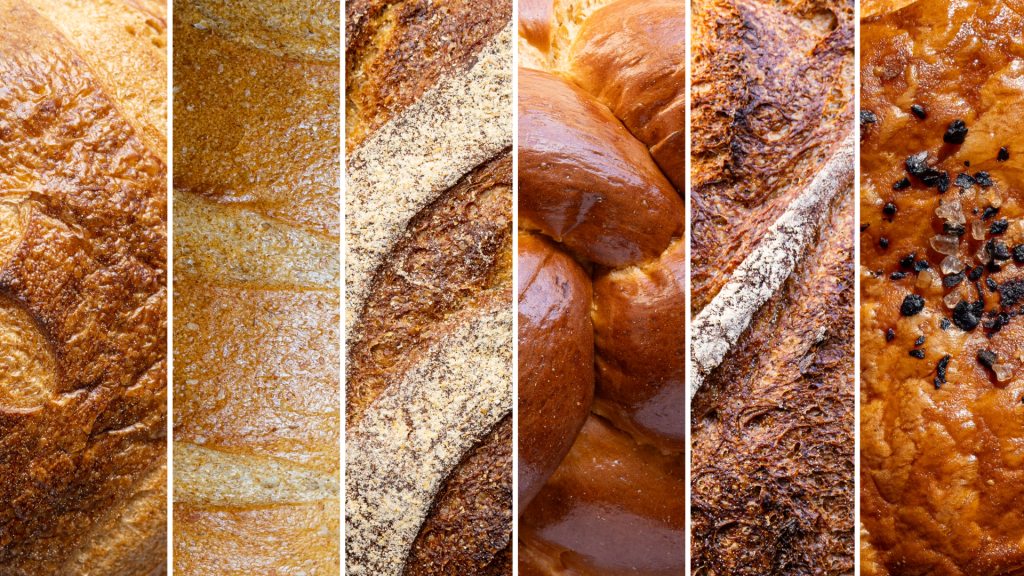
The flavors and aromas produced from these reactions can stop you in your tracks, ranging from sweet, toasty, and malty to savory, fruity, and buttery, with an edge of bitterness even. In some breads and pastries, steam combined with a moist dough surface also helps bring out an effect called blistering, where gases produced from strong fermentation are trapped under the surface of the dough, turning into tiny crunchy blisters as the crust forms (our Better Than San Francisco Sourdough and croissants being great examples).
A variety of crust colors and textures at the Bakehouse. From left to right: Better Than San Francisco Sourdough, Jewish Rye, Roadhouse, Challah, Country Multigrain, and Chile Cheddar Croissant.
When breads are not baked with enough steam or no steam at all, the crust turns out dull, not as crisp, sometimes thicker than ideal, and the coloring suffers. All this in addition to a possible blow out!
Steam will heat up your bread faster than dry air
What happens when you open the oven door mid-way through roasting a tray of broccoli? A puff of hot humid air escapes through. The moisture in the broccoli cooks off, turning into steam and you experience it when you first open that oven door. If it was just your oven heated up and you opened its door, it would feel hot, but not as hot. It’s because steam conducts heat way better than dry air. For bread, this means that a steamy oven, at least in the beginning of a bake, will help transfer heat to your dough much more effectively.
How to steam
So, whether you are a home baker or a professional baker, more often than not, you’ll want to send off your proofed breads or croissants on their final journey in the oven with a good kiss of steam. How do you do it then?
In your home oven, you have more than a few options. Here are a few that we like. We also recommend long oven mitts to help keep you safe:
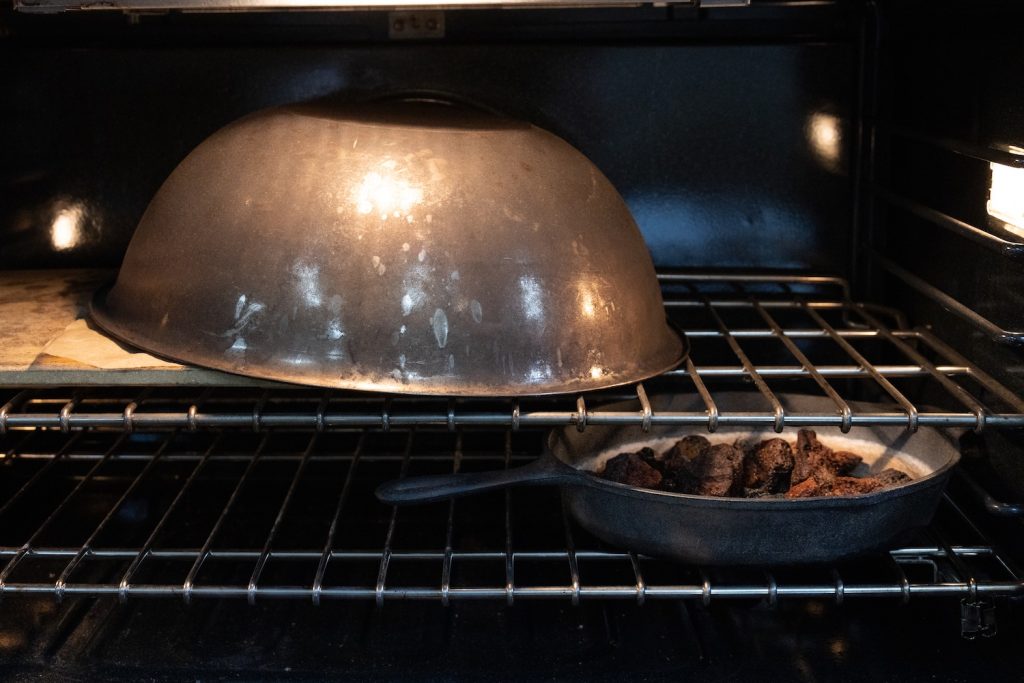
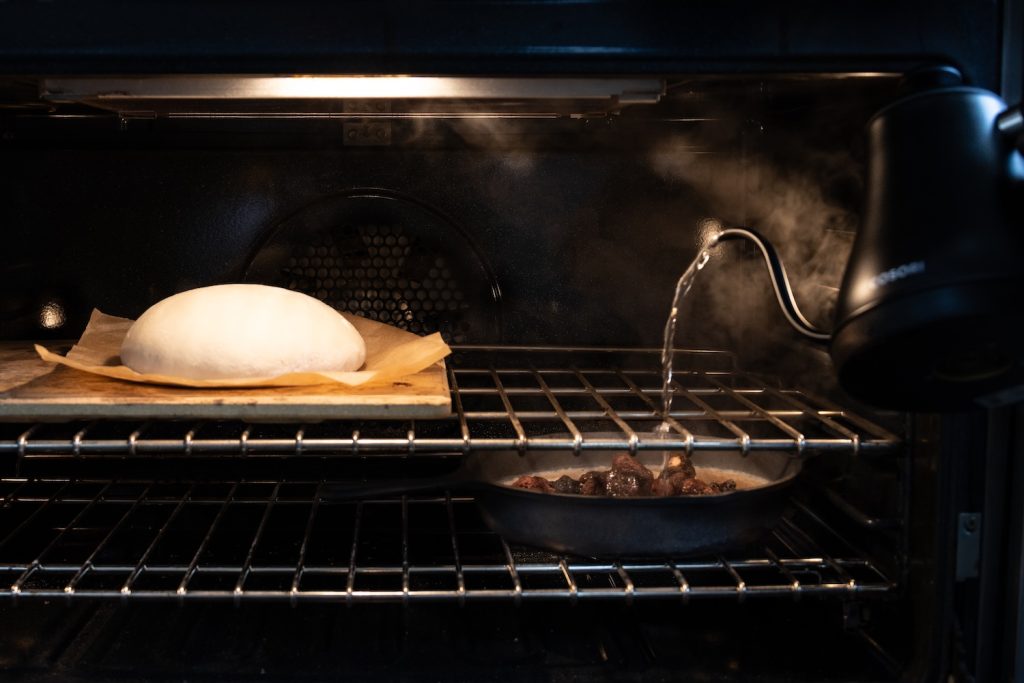
You can preheat your oven with a shatter-proof vessel, like a small cast iron skillet, placed on the bottom rack. When you load your bread onto the middle rack, carefully pour a half cup of water into the hot skillet and quickly close the door. This will help create a puff of steam.
If you are baking on a baking stone, placing a large inverted metal bowl on top of your loaf with its lip hanging over the baking stone to allow some steam in, can also enhance the effect.
If you want to turbo-boost the steam, try pre-heating some lava rocks in that steam vessel at the bottom of your oven and pouring boiling water in it as you place your bread in the oven. You will get a bigger, longer-lasting puff thanks to the surface area of the lava rocks. A bit before halfway through the bake, you can open the oven door (and remove the bowl if you used one) to release any residual steam.
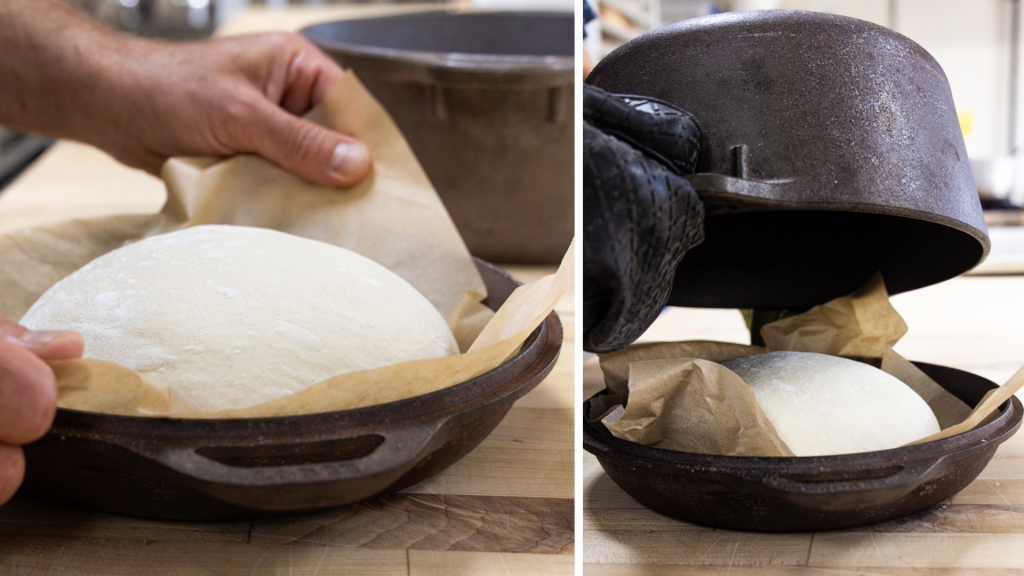
Another option, which some consider to be less of a hassle, is to bake your bread in a Dutch oven. The small heated chamber traps the moisture escaping from the baking dough, essentially returning it as steam for your bread. Almost halfway through the bake, you can remove the lid of the vessel and allow the bread to finish off baking in a dry oven.
And for those of you who are curious… In our bakery, we are lucky to have steam-injected hearth deck ovens and rotating convection ovens. These ovens have steam elements, concrete or metal, that supplement the baking chambers. After loading the bread, our bakers press the steam button and the pre-heated elements fill with water, which immediately turns into steam that fills up the oven chamber.
Another thing that helps create steam is the fact that the bakers load up each deck with as many loaves as possible. As they bake, they release moisture, adding even more steam to our ovens. As the doughs expand and open up, or bloom, along their scores, the bakers watch, and, at the right moment (i.e. just as the breads have expanded to their full potential), pull levers to release the steam or vent the oven chamber. This allows the breads to finish baking in a relatively dry oven, helping with coloration, proper crust development and cooking off excess moisture from the crumb.
If you are reading this, you probably agree with us that baking is an intricate dance with many steps. By experience, we know that steam is one of those last steps that can take your baked goods to the next level! If you want to experience this dance with us, join us at our hands-on BAKE! classes where we get to have fun learning about all the steps of baking.
Originally from the island of Cyprus, Hazim decided to immerse himself in the world of bread baking and all foods fully flavorful after a career in environmental engineering. He joined the Bakehouse team in 2016 with a focus on bread quality and innovation. You may find him at the bench with his baker friends rolling Farm dough, milling flours on our stone mills, teaching a Naturally Leavened Bread class at BAKE!, tasting breads, loudly (he calls it "passionately") elaborating on the benefits of whole-grain flours or temperature for sourdough baking, or stopping in his tracks to think about the next possible bread or improvement. Science is dear to him, and he loves windsurfing!! He was recently featured on Rise Up! The Baker Podcast with Mark Dyck talking about getting his start in baking, the tension of leaping into a new career, and working on a team where he can be his whole self.