The magic of bread baking is never lost on me. I still find myself giddy with anticipation when I load up my Dutch oven at home with a cold-proofed sourdough or in awe, admiring the ears of rows of perfectly baked French baguettes coming out of one of our ovens at the Bakehouse. I am still pleasantly surprised how my senses, most often than not, guide me in the right direction when I mix my sourdough starter so that the resulting dough temperature is just at the optimal range (it’s 78 – 82°F, if you are wondering). As all bakers would agree, we are all chasing the perfect bread of our imagination, and the chase is never over, at least for me.
To get the results we want, we learn and practice the many steps of bread baking, indulging in a delicious sensory experience each time. The step that we will get our hands—err, minds—into with this piece is mixing, where the magic starts to unfold. Join us for an overview of why we mix, the different levels of mixing and their effects on breads.
Why do we mix?
The goal of mixing is to bring ingredients together and form an intentionally structured dough where a myriad of physical, chemical and biological reactions start taking place for the bread that you are envisioning.
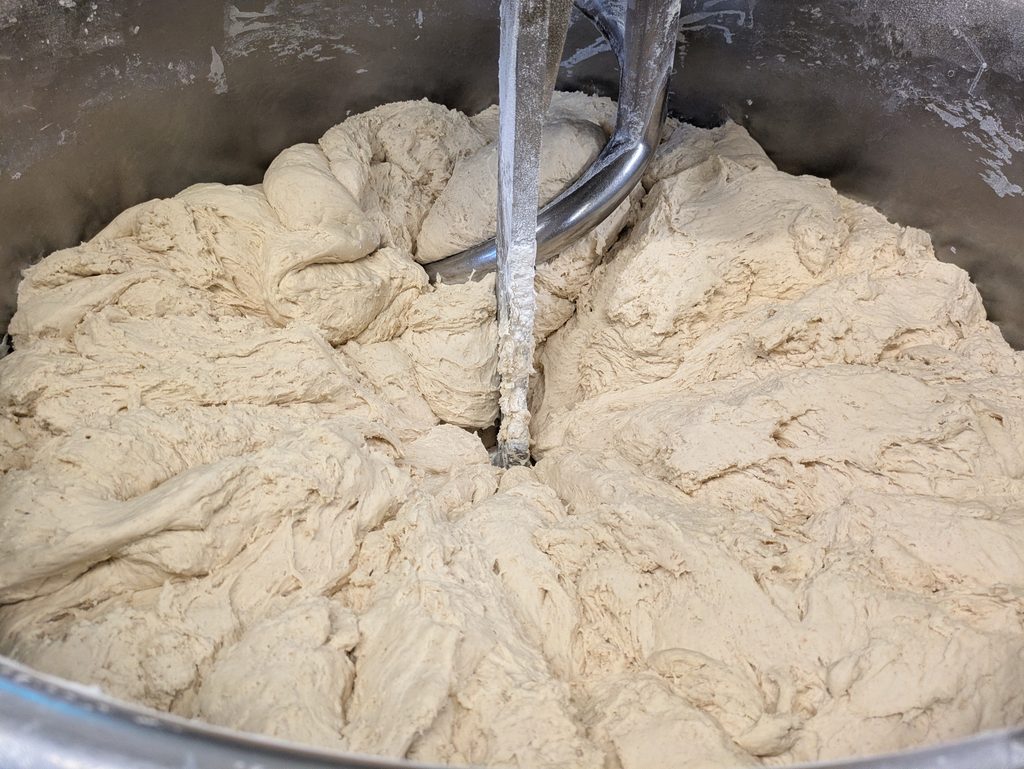
In the big picture, we can think of mixing in two stages. In the first stage, we are gently incorporating the dry and wet ingredients to start hydrating the dry ingredients, flour being the main ingredient. As the ingredients come together, we switch to the second stage of mixing, typically at a higher speed or intensity, where the goal is to develop an elastic stretchy dough that can later hold its shape and, if it’s a leavened bread, trap the gases and aromas formed by the leavening process.
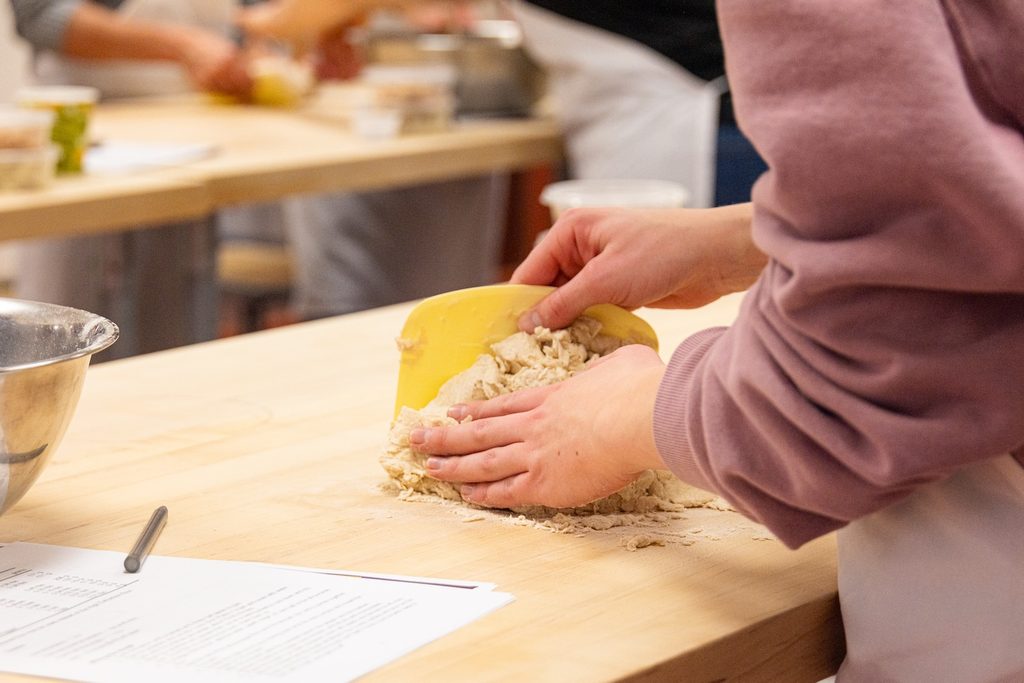
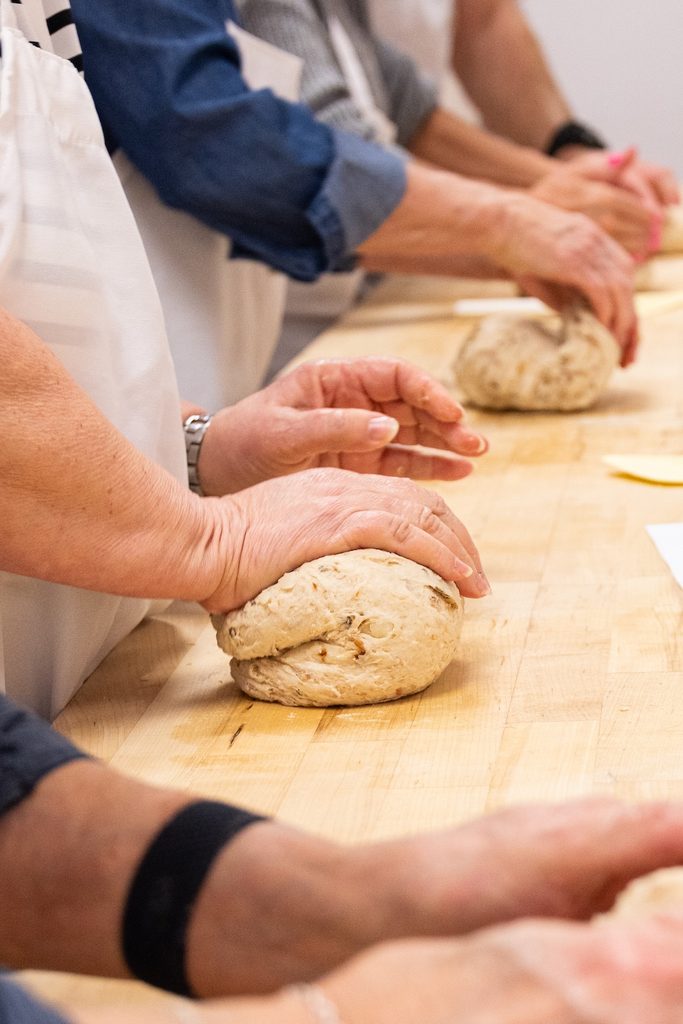
If you ever come to one of our BAKE! bread classes, you will notice that we typically knead a bread dough on the bench for 6 to 8 minutes. Students experience the dough going from shaggy, teary, barely-holding-together to a smooth and elastic, more cohesive mass that wants to stick to itself rather than their hands. That’s when we know and we tell them that their dough is ready for bulk fermentation and that they can stop kneading. Of course, the actual time of kneading may be slightly shorter or longer depending on the experience level of the baker. That said, this duration of kneading produces a dough that is neither barely kneaded nor so well developed, but more in the middle, and results in beautiful breads that a home baker can be proud of.
Inside the mixing bowl
Let’s take a closer look at what happens when we mix:
Ingredients disperse, dissolve or get absorbed.
Gluten-forming proteins of the flour, glutenin and gliadin, unfold.
As they get stretched and folded, a gluten network starts forming, also thanks to chemical bonds forming between gluten strands. The dough begins to feel more elastic (pulling back) and extensible (stretching). As the kneading or mixing continues, the gluten network gets stronger with sheets of gluten forming.
The dough gets ‘planted’ with microsites that will be filled with fermentation gases, i.e., “alveoli”.
Air is incorporated into the dough, causing some degree of oxidation, which further facilitates gluten bonding.
Enzyme activity that breaks down starches into sugars is facilitated as the enzymes are mechanically brought together with starch particles.
All this activity in the mixing bowl or on the bench results in what we feel as a bread dough with a somewhat moldable structure that is ready for the next step, i.e., in most cases, fermentation. A skilled baker mixes their bread dough only to the degree that is needed to achieve the desired results, and can do it by hand, by the aid of a mixing machine, or both.
Barely Mixed to Well Developed
On one end of the mixing spectrum are doughs that are barely mixed. These are breads that, when well executed, typically have an irregular, open crumb (think bigger holes) because the gluten network wasn’t as developed during mixing. These kinds of breads tend to have a bit more hydration and gain their strength and flavor via a relatively long fermentation. Gluten development is further aided by what bakers call stretch-and-folds during bulk fermentation, where the dough is stretched on each side and folded onto itself either on the bench or in its fermentation bin. The idea is to further criss-cross the gluten strands but in a very gentle way and at regular intervals. One can think of this as an extension of the mixing process. The resulting breads are typically not as voluminous, tend to highlight the sweetness and flavors of the grain, and have a longer shelf-life. A good example of this is our naturally leavened Green Olive Focaccia. It is a very wet, freshly milled whole grain sourdough that is barely hand-mixed in a bowl and gains its strength during a few stretches-and-folds and a lengthy overnight cold bulk fermentation. The resulting flat bread with irregular holes throughout and a pleasant moisture showcases the whole grain flavors and aromas, and serves as the perfect vehicle for the tasty topping on top.
At the other end of the spectrum, we have doughs that are heavily mixed in order to develop the gluten strength upfront. These types of doughs tend to be on the stiffer side and depend on enrichments (e.g., eggs, butter, sugar, etc..) and/or preferments (e.g., poolish, levain, etc..) for flavor development rather than a long fermentation, meaning mix to bake time is relatively short. The resulting breads are more voluminous with a softer eating, airier and finer crumb structure (think of the irregular big holes that have been divided into smaller ones and more uniformly distributed). Shelf-life on these types of breads are on the shorter side. Examples of this are the brioche or challah buns that we make, where a lot of flavor is imparted by the included enrichments (i.e. butter, eggs and sugar for brioche, and eggs, honey and oil for challah) and the structure of the doughs are developed with intense mixing.
In between are doughs that are mixed to a good level of gluten development and still depend on a decent length of fermentation to develop flavor and further strength. Our naturally leavened True North bread is a great example of that where the dough gets mixed gently on slow speed to incorporate ingredients and just a couple of minutes on faster speed, followed by one stretch-and-fold during bulk fermentation. Our poolish-based French baguette is another example. Ideally, it features a crisp crust revealing a lacy, cream-colored crumb with buttery, sweet and nutty flavors; a sign of gentle mixing, minimal oxidation and a fermentation schedule that brings forth the sweetness of the grain. A lot of our hand-kneaded bread doughs at BAKE! can also be considered to be in this category, where hand-kneading achieves a good level of gluten development yet some folds during fermentation help the bread gain some more structure and volume later on.
Mixer or By Hand?
Mixing by hand or using a mixer can get you great results. The main difference is that it would take you longer to achieve a similar level of dough development by hand than it would using a mixer. That is simply because the level of mechanical energy delivered from a mixer is typically higher than what your hands can achieve. This is especially true for professional style mixers, such as the very efficient spiral mixers. This is why when you are working with bread doughs that require a high level of kneading or mixing, such as brioche, use of a mixer can be helpful or you may need to knead your dough at the bench, using a technique such as the slap and fold, for a good amount of time to get similar results.
You may be wondering how long to knead or mix. This depends on the type of bread you are trying to make, or even the specific recipe you are using. The good news is that a good recipe will guide you in terms of the level of kneading or mixing required in order to make great breads. Even better yet, taking a hands-on class like the ones we teach at our baking school, BAKE!, can really help you get a better idea of the concept of mixing and how it plays an important role in baking together with so many other factors at play, such as fermentation, type of flours used and more.
Originally from the island of Cyprus, Hazim decided to immerse himself in the world of bread baking and all foods fully flavorful after a career in environmental engineering. He joined the Bakehouse team in 2016 with a focus on bread quality and innovation. You may find him at the bench with his baker friends rolling Farm dough, milling flours on our stone mills, teaching a Naturally Leavened Bread class at BAKE!, tasting breads, loudly (he calls it "passionately") elaborating on the benefits of whole-grain flours or temperature for sourdough baking, or stopping in his tracks to think about the next possible bread or improvement. Science is dear to him, and he loves windsurfing!! He was recently featured on Rise Up! The Baker Podcast with Mark Dyck talking about getting his start in baking, the tension of leaping into a new career, and working on a team where he can be his whole self.